With Kilian Jornet announcing his departure from Everest yesterday, I felt it was time to take a look around at the other expeditions currently going on in the Himalaya to check the status of their progress. In some cases, teams are already starting to look ahead to summit bids, which could come as early as late next week in some cases.
First off, now that Jornet has left Everest, Japanese climber Nobukazu Kuriki is the only one on that mountain this fall. He reports that he has now climbed up to 7000 meters (22,965 ft) and his acclimatization process is moving along about as well as can be expected. From the reports we've heard from the mountain, that won't be the challenge for him this year. Instead, it will be the deep snow that seems to be piling up on Tibet's North Side. Kilian mentioned the heavy snows as the main reason for his departure from the mountain, but for Nobu it is just another challenge to overcome as he attempts to climb solo, unsupported, and in alpine style without oxygen. For now, he'll just have to continue acclimating and waiting for his opportunity to push higher.
Alan Arnette is reporting that two climbers are taking an interesting approach to attempting a summit on Cho Oyu. Adrian Ballinger, who owns Alpenglow Expeditions, and his partner Emily Harrington are currently training in Tahoe, and are sleeping in altitude tents as they acclimatize as much as possible before they head to the Himalaya. Once they've wrapped up their preparation, they'll head to Tibet and try to climb the mountain in just two weeks total time. This holds true with the company's philosophy for climbing faster by preparing more ahead of time, which is used on other peaks too. A strategy that has come under fire from mountaineering purists from time to time.
Speaking of Cho Oyu, that continue to be a popular mountain this fall. There are currently no less than six commercial teams there, Base Camp has been a bit crowded this season. Most of those squads have now wrapped up their first round of rotations, with the next coming in a few days when they'll move up the slope to Camp 2.
On Manaslu, the Seven Summits Treks Team is proceeding on a quick schedule. The team is currently in the process of wrapping up its final acclimatization rotation after spending the night at C3. Sherpas from that team are working on fixing ropes to the top, and the large group of clients they brought with them are now preparing for a summit push. It has been rainy on the mountain, but there hasn't been a lot of snow. That bodes well for a potential weather window in another week or so.
Over on Dhaulagiri, the Altitude Junkies have started their acclimatization with a move up to Camp 1. They report several days of rain, but good weather moving into the picture now. Their Sherpa teams are now fixing ropes between C2 and C3, which they hope to wrap up in the next day or two. The team is feeling good, and are now eyeing a summit push on Sept. 25 or 26 depending on weather and wind conditions.
An RMI-led expedition reported to BC on Shishpangma a few days back, after driving to the mountain. They have already moved up to Camp 1, where they are finding conditions on the mountain to be quite good at this stage. It is early in the acclimatization process, but everything looks good so far.
As you can see, it is getting to be quite a busy season in the Himalaya. While not much is happening on Everest, there is a lot going on around the rest of the region. Of course, none of the big commercial teams are trying anything new this year, there are some smaller squads who will be pushing the envelope on some unclimbed peaks. We'll be keeping an eye on those expeditions moving forward too, and bring updates on the entire season as it unfolds. Stay tuned.
Jumat, 16 September 2016
Kamis, 15 September 2016
Video: The Last Rhinos - Would Legalizing the Sale of Their Horns Save Them?
Here's an intriguing video to say the least. It follows the efforts of John Hume, a man living in South Africa who happens to own five percent of the world's rhino population. Hume sued the government in South Africa to legalize the sale of rhino horns, arguing that if you sold them on the open market, it would bring the number of rhinos killed by illegal poachers down dramatically. It seems that when removed safely and properly, the horns will grow back, and the animal won't be killed. Could this be the answer to saving Earth's engendered rhino species?
National Geographic - The Last Rhinos from Brian Dawson on Vimeo.
Video: 72-Year Old Ultrarunner Completes Western States 100
And now for your daily dose of inspiration. In this amazing video, we meet 72-year old ultrarunner Wally Hesseltine, who set out to not only run a 100-mile (160 km) race, but perhaps the best known ultramarathon of them all – the famed Western States 100. He managed to finish that epic run in 30 hours, but that isn't the entire story. Watch the short film below and then go put on your running shoes. Amazing.
Thirty Hours from alex on Vimeo.
168 Years After Sinking in the Arctic the HMS Terror has Been Found
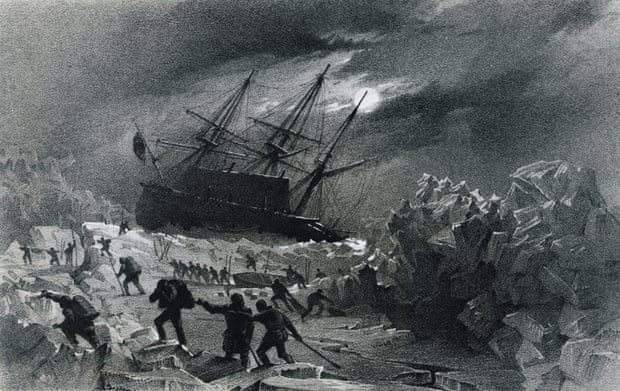
After years of searching in the Arctic, the missing ship of explorer Sir John Franklin has been found at long last. Earlier this week it was announced that the HMS Terror, a vessel that Franklin was using to explore the icy waters of the Northwest Passage, had been found after 168 years.
Franklin and his crew had been exploring the Arctic Ocean north of Canada back in 1848 when they ran into thick pack ice that prevented them from continuing their voyage. Both the Terror and its sister-ship, the HMS Erebus became trapped, forcing everyone onboard to abandon the two vessels. Eventually, all 129 members of the crew perished in the Arctic, and what became of the ships remained a mystery.
A few years back the Erebus was discovered by a search crew, but the location of the Terror remained a mystery. Now, thanks to a tip from a local Inuit tribesman, that mystery has been solved. The Terror was found in – of all places – Terror Bay, where its mast was spotted sticking out of the ice by passing hunters a few years back. That tip led to an archeological team going to the site to check out the area, only to discover the very vessel they had been searching for.
According to early reports, it seems that the ship is in relatively good condition, and may contain most of the things that were left onboard when it was abandoned by Franklin and his crew. In comparison, the Erebus has suffered hull damage, and Arctic currents had spread out its contents over a wide area. It'll be some time before salvage crews can truly get a look at the Terror however, so just what might be on the ship remains a mystery.
As for Franklin and his men, it seems that after they abandoned their ships, they began a long and perilous march across the Arctic with the hopes of reaching the Hudson Bay Company – a fur trading outpost far to the south. None of the men made it to the safety of that place however, vanishing in desolate white expanse of the north. Inuit oral histories talk about the foreigners passing through their area, but their ultimate fate has never been fully told.
The disaster that beset the Franklin crew is one of the worst in British naval history. It was quite a blow to that country, which ruled the seas and was pushing the boundaries of exploration at the time. Now, after more than a century and a half, at least part of the mystery has been solved.
Himalaya Fall 2016: Kilian Jornet Cancels Everest Speed Attempt
One of the current Himalayan expeditions that we've been watching closely has come to an end before it ever even had a chance to really get started. It was announced earlier today that Spanish ultrarunner Kilian Jornet has pulled the plug on his attempt at a speed record on Everest due to poor weather on the North Side of the mountain.
In a quote that was sent out via a press release a few hours ago, Jornet says “During the first few weeks we were acclimatising well and the conditions were good. However, when we were getting ready to prepare the attempt the weather began to change. There were some heavy snow storms and a large accumulation of snow. As a result, although we were in good physical shape, there was a high risk of avalanches and in the absence of good safety conditions it was impossible to climb.â€
Apparently, the expedition was actually nearing its conclusion when the decision was made to go home instead. There hasn't been a lot of news from Kilian or his team, but it seems acclimatization was going very well, and he was extremely happy with his progress. Unfortunately, heavy snow has been falling on the mountain over the past couple of weeks, and that was making the route much more dangerous. So much so that they made the wise choice of cancelling the summit attempt and going home instead.
Kilian says that he has learned a lot from the experience and will now return to Spain where he'll evaluate how this expedition went, and decide from there how to proceed. He has already indicated that next time around he'll do a few things differently both in preparation and acclimatization once on the mountain. He had spent three weeks training at 6500 meters (21,325 ft) which will give him a better understanding of the Everest environment the next time around.
Honestly, an attempt in the spring would probably provide more stable weather conditions, but Kilian would then have to contend with a lot more people on the mountain. For most of the time that he was there, he had Base Camp all to himself. We do know that Japanese climber Nobukazu Kuriki is also there for a solo bid on the mountain, but he didn't arrive until last week. It is unclear whether or not the heavy snow will impact his attempt to summit Everest, which will be his sixth time trying to accomplish that feat.
For now, we'll have to wait to see how Kilian does on Everest. Remember, he's never climbed an 8000 meter peak before. Hopefully he'll get another crack at it in the future. It will be interesting to see what an athlete of his caliber can accomplish there.
Arctic Explorers Bring Bad News After Sailing Northwest and Northeast Passages
One of the most ambitious and interesting adventures of the summer has been the Polar Ocean Challenge. Led by famed explorer David Hempleman-Adams, the objective of the expedition was to sail both the Northeast and Northwest passages in a single year, circumnavigating the North Pole and taking stock of the arctic sea ice along the way. A few days back the crew of adventurers, sailors, and researchers completed a major milestone of their journey, and they brought back some sobering news about the state of ice in the Arctic Ocean.
The sailing ship Northabout set sail from Bristol, in the U.K. back June, making way for Norway before proceeding on to Russia to the start of the Northeast Passage. The ship ran into a delay at that point due to pack ice still blocking the route. That isn't too uncommon in the early part of summer, as it generally takes a few weeks before the passage clears. From there, they navigated on through the icy waters of the Arctic before exiting into the Northern Pacific and crossing over to Alaska. The next stage of the journey was through the Northwest Passage above Canada, which is the section that was just completed. Now, the plan is to sail on to Greenland, and then back home to Bristol.
By successfully navigating through the both the Northwest and Northeast passages, the crew proved that those once mythical routes are now fully open, and accessible. They also became the first ship to make such a journey in a single season, although they certainly won't be the last. Climatologists now predict that both passages will see increasing numbers of commercial traffic before the middle of the century, even by ships that are not hardened against ice.
On the Polar Ocean Challenge website the team posted a press release a few days back sharing the news of their successful completion of the Northwest Passage, which took just 14 days to finish. That's an incredibly fast time through that part of the world, but the team revealed that they had encountered almost no ice along the entire route. In fact, in the two weeks that they spent there, they came across ice only twice in 1800 nautical miles (3333 km/2071 miles).
This news is both astonishing and troubling at the same time. It now seems pretty clear that both the Northwest and Northeast Passages will soon be open for longer periods of time each year, and that they will be safer than ever to pass through. The Arctic sea ice is a bit like the canary in the coal mine, giving us an indicator of just how much impact climate change is having on our planet.
The crew of the Northabout is on the home stretch now, having completed the most difficult sections of their voyage. The team's website shares some important information about their expedition, which has now been at sea for more than 20 weeks and covered over 13,500 nautical miles (24,076 km /14,960 miles). Perhaps the most startling statistic of all however, is that researchers about the ship have recorded a 13.4% drop in the sea ice levels, which is a faster and higher rate than was expected.
I suspect these kinds of reports will become the norm moving forward. It is still troubling to read however.
Rabu, 14 September 2016
Video: Wings of Kilimanjaro 2016 Expedition
Next week, 29 climbers will set out for the "Roof of Africa" as part of the Wings of Kilimanjaro initiative. The team, which is being led by my friends over at Tusker Trail, will attempt to trek to the top of Mt. Kilimanjaro, the tallest peak in Africa, where they will then paraglide off the mountain. But the group isn't there just to have an amazing adventure. They'll also be raising funds to support a number of projects that are improving the lives of people living in Tanzania. Those projects include installing pumps to deliver clean water, teaching local farmers to grow crops in a sustainable fashion, and improving the education of the children that live there. In the video below, you'll learn a bit more about the program, but you'll also see some amazing shots of their previous climbs up Kili, and the epic flights they've taken from the summit. It looks like a great way to see an already impressive mountain, and its all for a good cause.
Langganan:
Postingan (Atom)