Tampilkan postingan dengan label Mountaineering. Tampilkan semua postingan
Tampilkan postingan dengan label Mountaineering. Tampilkan semua postingan
Senin, 31 Oktober 2016
Video: Renan Ozturk - Obsessed or Devoted?
This video comes our way courtesy of The North Face and is part of the company's new #QuestionMadness marketing campaign which celebrates TNF's 50th anniversary. The clip focuses on sponsored athlete Renan Ozturk, who is amongst the best mountaineers/climbers in the world today. As with the other videos in this series, the question is where or not Renan is obsessed or devoted to his passion projects, which is a valid one for anyone who has seen the film Meru. But Renan isn't just trying to push the envelope in the mountains, but has other aspects to his character as well as you'll see here. Like most other outdoor athletes of his caliber, he is driven to be the best in whatever undertaking he sets his mind upon.

Himalaya Fall 2016: Controversy on Manaslu - 150 Summit without Actually Reaching the Top

Those in the know in the mountaineering world understand that there is a narrow ridge that is covered in a snow cornice that runs out to the actual summit of the mountain. That ridge is unstable and difficult to cross, particularly in high winds or other poor weather conditions. As a result, about 90% of the climbers this season turned back approximately 5 to 10 meters below the actual top of the mountain, but still claimed a full summit anyway. This has sparked some debate as to whether or not those claims are actually true.
In writing about a slew of climbing expeditions this fall, Alan Arnette also weighed in on the topic, sharing some of his own experiences. He also reminds us that a Japanese climber perished on Manaslu this year when he fell through the cornice while trying to reach the true summit. That's an indication of just how dangerous the final approach to the top truly is. Although as Alan points out via a quote from Himex boss Russel Brice, the blame is square placed on the team that was put in charge of fixing the ropes to the summit, but failed to complete the final 20 meters, which directly led to this fatality a few weeks back.
When considering where to actually give credit to someone for making the summit on Manaslu, it is important to also note that the incredibly narrow approach to the top serves as a significant bottle-neck for those going up and coming down. It would literally take hours for everyone to shuffle across the approach ridge, even if it were completely safe. That would leave climbers standing in line at the top of the mountain while they waited their turn, leaving them exposed to the elements the entire time. Most of the operators on Manaslu aren't willing to put their clients through that kind of difficulty, so they certify summits at the lower point on the mountain.
On the other hand, getting credit for a summit has always been about reaching the highest point. To take that away from experience doesn't seem completely fair either. Yes, it would mean fewer people climbing Manaslu if they actually had to negotiate that tough final portion of the ascent, but that isn't necessarily a bad thing either. There is a part of me that feels that if you want to actually receive a summit certificate you should have to reach the actual true summit to get credit. Anything else, just comes up short. It is up to the climbers themselves if they actually want to complete those final 20 meters or play it safe and turn back below that point. But if they don't get all the way up, the wouldn't earn full credit either.
Obviously this is a tough call. For safety sake, I understand why they turn back. But for the pure mountaineering aspects of it, they should actually touch the highest point in my opinion.
What do you think? Share your thoughts in the comments section below.
Kamis, 27 Oktober 2016
Video: Unclimbed - Reaching the Summit in the Himalaya (Part 7)
If you've been watching the fantastic series of "Unclimbed" videos from Discovery Canada, you'll definitely want to catch this latest episode. In this latest installment of the mountaineering series the team of Gabriel Filippi, Elia Saikaly, and Pasang Kaji Sherpa are reunited in Kathmandu before setting out to the Himalaya to the first ascent of several unclimbed peaks. But before they go, they must face down a mountaineering legend who has never summited a single peak – the indomitable Miss Elizabeth Hawley.
Himalaya Fall 2016: Summit Push Begins on Ama Dablam

Yesterday, the rope-fixing Sherpas on Ama Dablam reached the summit after waiting out poor weather conditions all of last week. The team of six mountain guides worked from Camp 2 on the mountain all the way to the 6812-meter (22,349 ft) summit in a single push, clearing the way for commercial teams that have been waiting in the wings. Now, with the ropes installed, it looks like there will be a mass summit push will begin in the next few days.
According to The Himalayan Times, more than 400 climbers will now move up from Base Camp to get into position to reach the summit. 200 of those alpinists are foreign climbers, while the others mostly consist of guides, high altitude porters, and the like.
It is unclear at this time exactly when the summit push will be completed, but with good weather in the forecast it seems like it should take place within the next few days. Unlike expeditions on other big Himalayan peaks, it doesn't take weeks to acclimatize on Ama Dablam, nor does it take numerous days to top out. Once the push begins, the summit should be very busy a few days later.
Ama Dablam is one of the most distinct mountains in the Khumbu Valley, with climbers and trekkers passing by on their way to Everest Base Camp. The beautiful peak is a good place for climbers to get valuable experience for what it is like to climb in the Himalaya prior to moving on to one of the 8000-meter peaks. For my money, it is still one of the most beautiful mountains that I have ever personally seen with my own eyes, creating a very memorable view on the trail to EBC.
Good luck to everyone heading up the mountain in the next few days. Get up and down safely and quickly, and enjoy the walk.
Rabu, 26 Oktober 2016
Video: Base Jumper Sets New World Record by Leaping Off Cho Oyu
Standing 8188 meters (26,684 ft) in height, Cho Oyu is the 6th highest peak in the world, and a popular climbing destination during the fall season in the Himalaya. A few weeks back, climber/BASE jumper Valery Rozov went up the mountain in an attempt to fly off the summit. He didn't quite make it to the top, but he did manage to don his wingsuit and leap from 7700 meters (25,262 ft), setting a new world record in the process. You can learn about his expedition, and see his flight in the video below.
Everest Air Premieres Tonight and I've Seen the First Episode

Over the past several weeks you've read my post announcing the show as well as my interview with Jeff Evans, one of the key players on the program and an emergency first responder who helps provide medical aid to climbers, Sherpas, and a variety of other people living in the mountains of Nepal. Naturally, after speaking with Jeff and receiving a number of press releases from the Travel Channel regarding Everest Air, I've been anxious to see how the show turned out. Now, after getting the chance to watch the first episode, I can assure you that it lives up to its billing as a realistic depiction of life in the Khumbu, and what it is like to conduct a rescue above 20,000 feet (6096 meters)
One of my biggest concerns when ever there is a reality show based around Everest is that the climbing scene there will be exploited for ratings. We've seen it time and again on various networks, which only seem to focus on the relatively few deaths that occur on the mountain each year, rather than the hundreds of successful summits. There have even been reports of another network filming on the mountain this past spring that was taking a similar approach. I'm happy to say that Everest Air does not fall into this category and while watching the show I didn't feel like it felt exploitative at all.
The first episode does a good job of introducing the viewer to the primary characters that we'll be following over the next six week, of which Jeff Evans is only one. We also meet other medics, communications coordinators, helicopter pilots, and support crew that all play a vital role in running the air rescue operations and saving lives on Everest and throughout the Khumbu Valley. The team isn't there just to rescue wealthy western climbers, but to lend a hand to the Nepali people too. In fact, some of the more interesting and dramatic medical emergencies revolve around the Sherpas who live and work in the shadow of the tallest mountain on Earth.
Having been to Everest Base Camp it was a lot of fun for me to see some of the more memorable landscapes throughout the region. The crew that filmed the show never appear on camera, but they are some of the unsung heroes of the show for sure. The Himalaya look impressive on screen and while the production team was there to film the med team in action, there is still plenty of eye-candy in the form of jaw-dropping scenery too.
Everest Air gets off to a fast start, with some daring operations by the helicopter pilots and the rescue squad in the first episode. I don't want to spoil too many of the details, but I can tell you that each of the missions are a good indication of what the remaining episodes will be like. You'll get a first hand look at the effects of altitude sickness, as well as some of the other injuries and afflictions that anyone living in – or visiting – the Khumbu Valley face. Seeing some of the symptoms of pulmonary and cerebral edema manifest in patients is highly sobering, and will help you gain even more respect for the men and women who attempt to climb the big mountains. It'll also provide plenty of respect for Jeff and his team as they deal with the consequences too.
Whether you're someone who follows the Everest climbing scene closely each year, or just have a passing interest in the Himalaya in general, you're likely to really enjoy Everest Air. But beyond that, if you want to see a real-life drama, played out on a massive and grand stage, this show will keep you riveted as well. This is true reality TV, where the decisions that are made are literally a matter of life and death. It is hard to top true human drama, and this show has that in spades.
Check out the preview for Everest Air below, and catch the show starting tonight at 10:00 PM Eastern time.
Senin, 24 Oktober 2016
The First Woman to Summit Everest Has Passed Away

Tabei was instrumental in opening up the sport of mountaineering for other women to follow, both in her home country and internationally. Back in 1969 she established a ladies-only climbing club back in Japan and began promoting the idea of women-only mountaineering expeditions. At the age of 35 she led a squad of Japanese women to Everest in an attempt to make the first female ascent of the highest mountain on the planet, proving that women could indeed reach that point in the process.
Throughout her climbing career, Junko visited more than 60 countries, scaling the highest peaks in each of those nations. In 1992 she became the first woman to complete the Seven Summits as well, as she stood on top of the highest mountains on each of the seven continents. Despite being diagnosed with cancer four years ago, she continued to pursue her dreams in the mountains right up until the end.
My condolences go out to Junko's friends and family. She was a towering figure in the mountaineering community who broke new ground for female climbers everywhere. Her visionary approach to climbing helped open the door for many other ladies to follow, and she will be missed.
Jumat, 21 Oktober 2016
Himalaya Fall 2016: Kuriki Calls it Quits on Everest, Vows to Return

You may recall that Kuriki launched a summit bid on the North Side of Everest on October 6, only to be turned back a couple of days later due to deep snow high up on the mountain. In that attempt, he made it as high as 7400 meters (24,278 ft) and was preparing for the final push to the top, but the route was covered in snow that came up to his waist. That heavy snow made it impossible to break trail on his own, so he wisely decided to descend back to Base Camp to reassess his options.
After spending a few days back in BC watching the mountain and regaining his strength, Kuriki took a look at the weather forecast and found it to be very unfavorable. The jet stream was moving over the summit of the mountain, making it impossible to summit for the foreseeable future. He realized that his chances of climbing Everest in 2016 were coming to an end, and his home team reports that he broke down in tears with the realization.
This was Nobu's sixth attempt at climbing Everest solo in the fall, and apparently it won't be his last. He has already said that he plans on returning next year to give it another go, and considering the level of determination we've seen out of him in the past, I would expect to see him back on the mountain again next year if at all possible.
Kuriki is an enormously popular figure in his home country, and in order to fund this expedition he launched a very successful crowdfunding campaign. Whether or not he can do that again remains to be seen, but part of the disappointment he has felt in not completing the expedition comes from the feeling of disappointing all of those who have supported him. As we all know however, mountaineering is not an exact science, and conditions have to be just right to be successful. Particularly on a peak like Everest when you are completely alone. Something tells me that his supporters understand this as well, and will be willing to back him again in the future.
To my knowledge this is the last expedition taking place on an 8000-meter peak in the Himalaya at the moment, although there may be a few smaller teams that have slipped below my radar. There are some ongoing climbs on 6000 and 7000 meters peaks however, so stay tuned for more updates as they happen.
Kamis, 20 Oktober 2016
Video: Unclimbed - Reaching the Summit in the Himalaya (Part 6)
Discovery Canada has released another episode of their fantastic series of mountaineering videos entitled Unclimbed. If you've been following along with the series, you know that it has been following climbers Gabriel Filippi and Elia Saikaly as they prepare to attempt the first ascent of several unclimbed peaks in Nepal. Up until now however, we've seen very little of the third member of the team – Pasang Kaji Sherpa. That changes with this episode however, as we are introduced to Kaji and learn more about his way of life. Born and raised in the big mountains, he is an expert mountaineer, and a crucial part of the team. Learn more in the clip below.
Rabu, 19 Oktober 2016
Video: The North Face Athletes Question Madness - Conrad Anker and Alex Honnold
Yesterday, I shared a video that launched a new brand campaign from The North Face that invited us to "Question Madness." The campaign celebrates the 50th anniversary of the company, which has become synonymous with outdoor adventure and exploration. Today, I have two more videos from that exemplify what the company is going for by introducing viewers to some of their sponsored athletes. In this case, those two people are mountaineer Conrad Anker and rock climber Alex Honnold. Check them out below.
Selasa, 18 Oktober 2016
Video: The North Face Invites Us to Question Madness
The North Face has just launched a new marketing campaign using the hashtag #QuestionMadness. Much like the famous "Think Different" ads from Apple Computers back in the day, this campaign introduces us to some of TNF's sponsored athletes. People like Conrad Anker, Alex Honnold, and Renan Ozturk, who are pushing the edge of adventure and exploration. Are they mad or are they geniuses? That is the question, and in this beautiful video we get an opportunity to see them doing what they do best, while we ponder whether or not it is all worth it or why they pursue these challenges. If you read this blog with regularity, you probably already know the answer to that. Particularly on your own personal level. Enjoy!
Will Ueli Steck Attempt Everest-Lhotse Traverse in Spring of 2017?

Recently, Nestler caught up with Steck at the International Mountain Summit in the Dolomite mountains of Italy. They talked about what Ueli has been up to recently, which included a climb on Shivling in India to celebrate his 40th birthday. On that expedition he traveled with his wife, and kept the climb low-key, not even alerting media to their plans. While they were there, they also met and shared Base Camp with Polish climbers Grzegorz Kukurowski and Lukasz Chrzanowski, who ended up later perishing on that mountain.
In the interview, Ueli also talks about what it is like getting older, and that while he can still go fast ni the mountains, he finds that it takes him longer to rest and recover. He's also learned that he doesn't necessarily want to take the big risks that he has in the past, although he estimates that he has another five years of big expeditions ahead of him.
But perhaps the most interesting aspect of the story is when Nestler asks him about his plans for the future. Steck says that his next project is another attempt on making the Everest-Lhotse traverse which would involve a summit of the tallest mountain on the planet, followed by a daring crossing of the ridge that links it to its neighbor Lhotse, where he would nab another summit along the way. "The Swiss Machine" doesn't give any indication of exactly when he'll give this expedition a go, but it seems that it could be on his radar for the spring 2017 climbing season in the Himalaya. Naturally, he'll be making the traverse and both summits without oxygen.
Ueli tells Stefan that he'll make the climb as part of a two-man team, with only Tenji Sherpa joining him on the expedition. Tenji was with him in 2012 when Ueli summited Everest, and the two have enjoyed several other expeditions in the Himalaya together as well.
The 2016 fall climbing season isn't completely over just yet, but we already have something to potentially start looking forward to in 2017. As always with Ueli, it should be a fun expedition to follow. Stay tuned.
Senin, 17 Oktober 2016
Video: Unclimbed - Reaching the Summit in the Himalaya (Part 5)
Discovery Channel Canada has released the latest episode of its Unclimbed series, which follows mountaineers Gabriel Filippi, Elia Saikaly, and Pasang Kaji Sherpa as they attempt to make several first ascents in the Himalaya this fall. In this episode, Gabriel and Elia travel to Peru to continue their preparation for the challenges they'll face in Nepal. This training expedition is overshadowed a bit by a previous attempt in the Andes, with the ghosts of that past climb impacting their current situation. If you've been watching this ongoing series, you'll definitely want to catch up with the team in this latest installment.
Himalaya Fall 2016: Commercial Expeditions Head Home, Missing Climber on Manaslu

Now that mid-October has arrived, the commercial squad in the Himalaya this fall have pretty much wrapped up their operations and headed home. Prior to my departure for Majorca, most of the busy mountains – including Manaslu, Cho Oyu, Shishapangma, and Dhaulagiri – had seen the bulk of their summits for the season with the larger squads packing up their gear and heading home. Now, they are all but abandoned until spring, when more climbers will arrive to test their skills and resolve on each of those peaks.
Of course, the season isn't quite over yet, and there are a few ongoing expeditions that we'll continue to keep an eye on. For instance, Japanese climber Nobukazo Kuriki is still on Mt. Everest and hoping to pull of a solo summit of that peak before he heads home. When last we checked in on him, he had abandoned a summit push due to heavy snow on the mountain, but had returned to Base Camp to gather his strength for another go. Last week, after regaining some energy, he headed back up to Camp 1 only to find that the winds were too strong to allow a safe ascent up the mountain. He is now back in BC and waiting for conditions to improve. The weather window will start to close soon however, particularly as November draws closer. For now though, Nobu is remaining patient and looking for opportunities to summit, despite very heavy snows.
Sadly, there were a few tragic stories to report from the past week as well. On Manaslu, for instance, a 24-year old Japanese climber by the name of Hirotaka Onodera went missing on October 7 after reaching the summit on that mountain. Reportedly, he topped out along with his team leader, but then slipped and fell while taking summit photos for another climber. All attempts to locate the missing man have failed to turn up any results.
Elsewhere, a guide named Ang Chhongba Sherpa fell to his death after losing his footing while collecting ropes after a successful summit bid on the 6119 meter (20,075 ft) Lobuche East. He was a member of a four-man squad that had topped out previously in the day and were making their way back down the mountain. The accident occurred at about 5800 meters (19,028 ft) and Chhongba's body was later recovered by a recovery team following a 20-hour search.
I'll continue to keep an eye on any developing stories from the Himalaya in the days ahead. Things are definitely getting quieter there, but there are still several teams pressing forward with their expeditions.
Jumat, 07 Oktober 2016
Himalaya Fall 2016: Kuriki Retreats – for Now

Apparently, Nobu reached as high as 7400 meters (24,278 ft) before turning back. He was feeling strong and ready for the challenge of topping out on the world's highest peak, but encountered deep snow along the route that made it very difficult to make any progress. Exhausted from his efforts, he decided to turn back, and is now safely back down to 5800 meters (19,028 ft) and will descend back to ABC after he has rested there.
According to his Facebook page, Kuriki isn't giving up on his dream of a solo summit without oxygen however. He'll now rest up and regain his strength, while waiting for another solid weather window. After that, he'll weigh his options and hopefully have another go at the summit. That is likely to take place sometime next week at the earliest. Thankfully, he is said to be in good health, feeling strong, and in positive spirits. Perhaps we'll see him stand on top yet this season.
Finally, we do have an update from the Altitude Junkies today as well. After encountering heavy snow on the summit push last week, the team pulled the plug on their expedition and have now returned to Kathmandu. The group had hoped to summit on October 1, but a surprise storm dumped a meter of snow on the mountain, creating unstable conditions. After assessing the danger of avalanches, the team decided that it was in the best interest and safety of everyone if they left the mountain. Helicopters picked them up a few days back and with the entire squad now safe in the Nepali capital, they're all preparing to head home.
That's it for now. I'll keep an eye on any developments while I'm away. More updates soon.
Kamis, 06 Oktober 2016
Reminder: October 14th is a National Day of Adventure

While not an official holiday of course, the entire point of the NDOA is to encourage people to get outside, engage in their favorite outdoor activities, or perhaps even try something new. To that end, the two sponsors of the Day of Adventure have helped organize more than 30 events across the U.S. to give us all a starting point for getting our adventures off to a good start.
While I'll actually be in Spain on that day, I'll certainly take some time to hit a trail and do some hiking, or possibly even some snorkeling in the Mediterranean Sea. And since it is a Friday, hopefully some of you will take part in the celebration by heading out to enjoy your own adventures too. Why not skip out of work early, grab your mountain bike and take a ride on your favorite trail? Or, gather up some friends and take a scenic hike somewhere before grabbing some dinner and drinks afterwards. The whole point is to add a little excitement and adventure back into your life, something that hopefully we do on a more regular basis than one day a year, but it is a good place to get started never the less.
So, whether your like to ride, hike, run, paddle, fly, climb, or some other crazy outdoor activity, don't forget to set a little time aside to pursue that passion next Friday. After all, you'll never regret the days that you do the things you love, and you might just discover other passions along the way.
Get out there and enjoy!
Himalaya Fall 2016: Japanese Climber Begins Solo Summit Bid on Everest
According to Kuriki's support team, he will climb along the Hornbein Couloir route in his attempt to reach the summit. There is some speculation that he will make that approach along what is known as the Supercouloir Route, which is a combination of a route opened by a Japanese team back in 1980 and the Hornbein. If all goes according to plan, he should potentially top out sometime in the next couple of days.
Kuriki himself has been updating his Facebook page with updates as he goes. His most recent post indicates that he has reached his high camp and will set off for the summit possibly late Friday or early Saturday morning local Nepali time. Weather conditions are reportedly quite good, and while there has been a lot of snow deposited along the route, Nobu appears to be making good time on his way up.
If you are familiar with Kuriki's previous attempts on Everest, you probably already know what a successful summit would mean to him. As already mentioned, he has made five previous attempts at a solo summit on the mountain, one of which ended in disaster. In 2012, the Japanese climber became stranded high on the South Side in Nepal, and had to be helped down by a rescue team. While he was stuck at altitude, he suffered severe frostbite to his fingers and toes. He ended up having nine of his fingers amputated, and yet he continues to return to the mountain on a regular basis to test his strength and determination. Hopefully this time his efforts will pay off. Hopefully he'll also get up and down safely.
Over on Dhaulagiri we're still waiting on word from the Altitude Junkies about their plans. The team has hoped to summit that mountain this past weekend, but turned back after finding unexpectedly deep snow at Camp 2. They had returned to Base Camp, where they were pondering their next move, but since that time there has been now word on their decision. It is possible they are waiting out the weather and hoping to launch another summit attempt in the next few days, but they could also be preparing to clean up BC and head home. For now, we'll just have to wait to see what happens.
That's it for today. I'll be keeping a close eye on Kuriki's progress and will post updates as we hear more.
Rabu, 05 Oktober 2016
Video: Climbing the South Face of Annapurna
In terms of pure altitude, Annapurna ranks 10th amongst the 8000 meter peaks, topping out at 8091 meters (26,545 ft). But when it comes to level of difficulty to climb, it ranks second to perhaps only K2. In fact, it is considered the most dangerous mountain on the planet by many thanks to its frequent avalanches and technical challenges, and yet it continues to hold an allure over many climbers who travel to its flanks each spring to have a go at the summit.
This video a short documentary about such a climb. In it, we join famed Swiss mountaineer Jean Troillet as he attempts Annapurna back in 2012. The clips gives us some impressive shots of the mountain, and provides plenty of insights into what it takes to take on such a difficult and dangerous climb. If you're a fan of Himalayan expeditions to the big peaks, you'll definitely want to watch this short-film, which takes us along on one of the toughest climbs of all.
This video a short documentary about such a climb. In it, we join famed Swiss mountaineer Jean Troillet as he attempts Annapurna back in 2012. The clips gives us some impressive shots of the mountain, and provides plenty of insights into what it takes to take on such a difficult and dangerous climb. If you're a fan of Himalayan expeditions to the big peaks, you'll definitely want to watch this short-film, which takes us along on one of the toughest climbs of all.
Adventure Blog Interview: Jeff Evans of Travel Channel's Everest Air
 |
| Jeff Evans inside a rescue helicopter at Everest Base Camp |
For two months during the 2016 climbing season, a dedicated and experienced team of Sherpas and helicopter pilots, led by experienced mountaineer and medic Jeff Evans, went to great lengths to rescue climbers, guides, and local Nepalis living in the Khumbu Valley alike. "Everest Air" will give us a glimpse of what those operations were like, and how Jeff and his squad impacted the lives of those they helped.
Recently, I had a chance to chat with Jeff to get his thoughts on the show, the Everest climbing seven, what it was like conducting high altitude medical operations, and a lot more. It was clear from our conversation that this wasn't just a television gig for him, but a chance to give back to both the mountaineering community and the Nepali people.
An adventurer and outdoor athlete, Jeff grew up in the Blue Ridge Mountains of North Carolina, where a love of the outdoors was instilled at a very young age. As he grew older, he immigrated west to Colorado where he attended college at UC Boulder where he studied medicine as he worked towards becoming a physician's assistant. While there he also continued to hone his climbing skills, which would later take him up some of the more famous routes in Yosemite, Rocky Mountain, and Joshua Tree National Parks. Later, he would branch into mountaineering as well, and eventually become a guide – and conducted search and rescue operations – on Denali in Alaska. In 2001, he even summited Everest along with blind climber Erik Weihenmayer, a long time friend that he would share many adventures with.
Last year, following the tragic earthquake that hit Nepal, Jeff returned to that country to help lend a hand. His experience as a search and rescue operator, along with his training as a medic, allowed him to play a vital role in the difficult days that came after that natural disaster. His deep love for the Nepali people, and a place that has given him so much throughout his climbing career, spurred him into action then, and was a major reason why he wanted to return once again this year to be a part of "Everest Air."
 |
| Working on a patient at EBC |
But before he officially took the gig, Jeff says he told the producers that if he was going to be a part of the team, they had to truly be of service on the mountain. He didn't want the show to revolve around rescuing rich, inexperienced mountaineers who found themselves out of their element on Everest. He wanted to have a meaningful impact beyond the privileged foreign climbers that showed up in large numbers in the Himalaya. He said that the show's creators agreed with his vision, and promised that they weren't going to Nepal to exploit Everest for ratings – it was a promise they stuck to throughout filming.
Jeff and the members of his team gathered in Kathmandu on April 1, and stayed in the country until June 1. During that time, they made 89 total flights and conducted 38 rescues, of which 24 of those operations were in support of locals, including assisting a Nepali woman who had suffered a miscarriage. For Jeff, this was exactly what he had hoped for – assisting mountaineers in need, but more importantly lending a hand to locals who were in dire need of medical attention.
Most of the ailments that the foreign climbers suffered typically revolved around altitude sickness, with both pulmonary and cerebral edema being very common. But, over the course of two months they also helped individuals who suffered other injuries as well, including a broken back, a bowel obstruction, and one person that had taken a 30-foot fall. "Had we not been there," Jeff says, "more people would have died on Everest this season."
Despite his experience as a medic and a climber, adjusting to flying through the Himalaya in a helicopter took some time. "At first I wasn't comfortable in the back of the helicopter," Jeff tells me. "They're just not meant to be flown at those altitudes," he adds. But over time, and as he got to know the talented pilots, he learned to trust them more. "By the end of production, I was getting along just fine."
 |
| Jeff with Bhaila Sherpa of Alpine Rescue Services |
Jeff tells me that he is proud of how production went in Nepal, as he and his team stuck to the values they had hoped to adhere. Mainly, help those in need and make a difference in the local communities, something that will be evident when the show debuts. He also says that the entire production crew showed a great deal of respect for the individuals the medical team were assisting, something that runs counter to the reports we've heard from another television network crew that was operating on Everest at the same time.
With just six episodes to show us the entire spring climbing season, "Everest Air" is likely to be quite the action packed show. Obviously they won't be able to show us all of the rescues they conducted, but you can count on plenty of edge-of-your-seat moments for sure. When I asked Jeff if there were any particular rescues that stood out the most, he quickly rattled off a string of different situations that came to mind. In the end, he settled on the operations they conducted that helped the local Nepalis the most as the ones that he'll always cherish.
As viewers, we'll get to decide which of the team's adventures are the most entertaining and dramatic. "Everest Air" will debut in three weeks time on the Travel Channel starting at 10 PM Eastern Time. Be sure to tune in or set your DVR's accordingly.
(All photos courtesy of Jeff Evans)
Himalaya Fall 2016: Climbers Make Controversial Speed Ascent of Cho Oyu
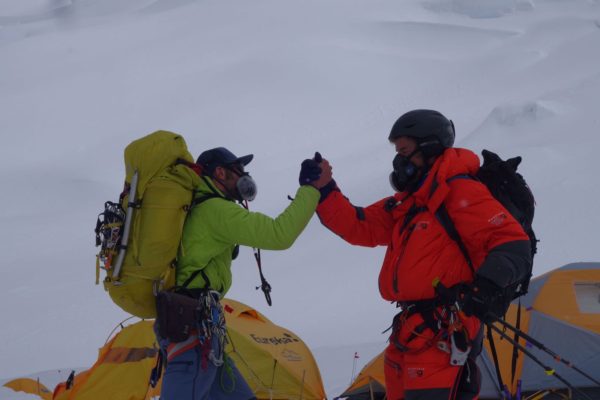
Last Sunday, Adrian Ballinger – of Alpenglow Expeditions – and his partner Emily Harrington completed a successful summit of Cho Oyu, the sixth highest mountain on the planet at 8188 meters (26,884 ft). That in and of itself wasn't too unusual, as a number of teams topped out during a great summit window last weekend. But, Adrian and Emily did it just ten days after leaving their home in California, something that has been unheard of until now.
Typically on a big Himalayan peak it takes weeks to acclimatize to the altitude. Most climbers arrive in Kathmandu two months prior to their projected summit date. They then travel to their respective base camps, follow a set process for acclimatization by going up and down the mountain several times, and wait for good weather to make a summit bid after their bodies have acclimated to the thin air. That can sometimes take 4-6 weeks, depending on conditions and the climbing schedule.
But Adrian and Emily trained back home using altitude tents to simulate the conditions they would find on the mountain. These tents were able to create an environment that closely approximates the thin air of a big Himalayan peak, but it allows them to stay home, sleep in their own beds, and have the comforts that they are typically accustomed too. Meanwhile, a support team established a Base Camp for them on Cho Oyu, making it ready for their arrival.
Two weeks ago, Ballinger and Harrington left the U.S. to fly to Nepal and then traveled to Tibet to reach the mountain. By the time they reached BC, they were fit, acclimated, and pretty much ready to go. Once the weather window opened last week, they were able to safely climb to the top, taking two clients who had prepared in a similar fashion along with them.
This approach to acclimatizing at home and shortening the length of an expedition isn't new. In fact, it is something that Ballinger and Alpenglow have been working on for some time. The company's Everest expeditions are just a month in length thanks to this novel program, and now he has proven that he can shorten the time considerably on shorter peaks too. This allows clients to spend less time on a potentially dangerous mountain, while having to be away from home for fewer days too. That makes it vacation friendly as well. The downside? An Alpenglow expedition is considerably more expensive than the competition.
This new approach has rankled some in the mountaineering community in the past, but this new Cho Oyu speed ascent has many talking once again. For some, it is an innovative new way to climb in the Himalaya, while others feel like it is still a bit unproven and could be potentially risky. There are those who see it as a bit of "cheating" – for lack of a better word – as well. Those detractors tend to be old school climbers who often consider the use of bottled oxygen as a performance enhancing drug too.
Either way, this could be the future of mountaineering. Alpenglow will of course continue to pursue this novel training technique with the idea of attracting more clients who want to climb on the big peaks, but don't necessarily have two months to dedicate to that proposition. As Ballinger and his team continue to refine their methods, I'm sure more than a few other climbers and guides will be looking to employ similar techniques to aid their expeditions as well.
Langganan:
Postingan (Atom)