Selasa, 06 September 2016

Search for Missing American Climbers in Pakistan Called Off

Last week the news broke that American climbers Kyle Dempster and Scott Adamson had gone missing while climbing the Ogre II in Pakistan. At the time, we had heard that desperate family members had launched a GoFundMe page asking for donations to help pay for a search and rescue operation, with the climbing community responding by donating more than $197,000 to help with those efforts. But today we get the sad news that the search for the two men has been called off, with both now presumed to be dead.

Dempster and Adamson were last seen climbing the 7285 meters (23,901 ft) mountain, which also goes by the name of Baintha Brakk, back on August 22. At that point, they were moving up the slopes with the hopes of making a summit bid on the a peak that is considered one of the toughest in the world. Their camp chef reported that he could clearly see their headlamps on the ascent, but later clouds moved in, shrouding them from sight.

Since then, there has been no sign of the men, who were due back in Base Camp by August 26. A few days later, the search and rescue operation was launched, although those efforts were thwarted by poor weather.

This past Saturday, September 3, two helicopters were finally able to get into the air and survey the landscape on and around the mountain. The crews of those two teams, aided by mountaineer Thomas Huber, made an extensive search of the routes that Kyle and Scott had intended to ascend and descend by, as well as the rest of the mountain as well. Those searches turned up no signs of the missing men, and by the end of the day the helicopters returned to their base empty-handed.

Experts now believe that considering how much time has passed since they were last seen, and the ongoing poor weather in the area, that there is very little hope that the two men could have survived this long. With that sobering thought in mind, they have now called off further search operations.

This is obviously sad news for the mountaineering community, but more so for the friends and families of the two missing men. My condolences to those who were closest to them.

Kayakers Complete Greenland to Scotland Challenge

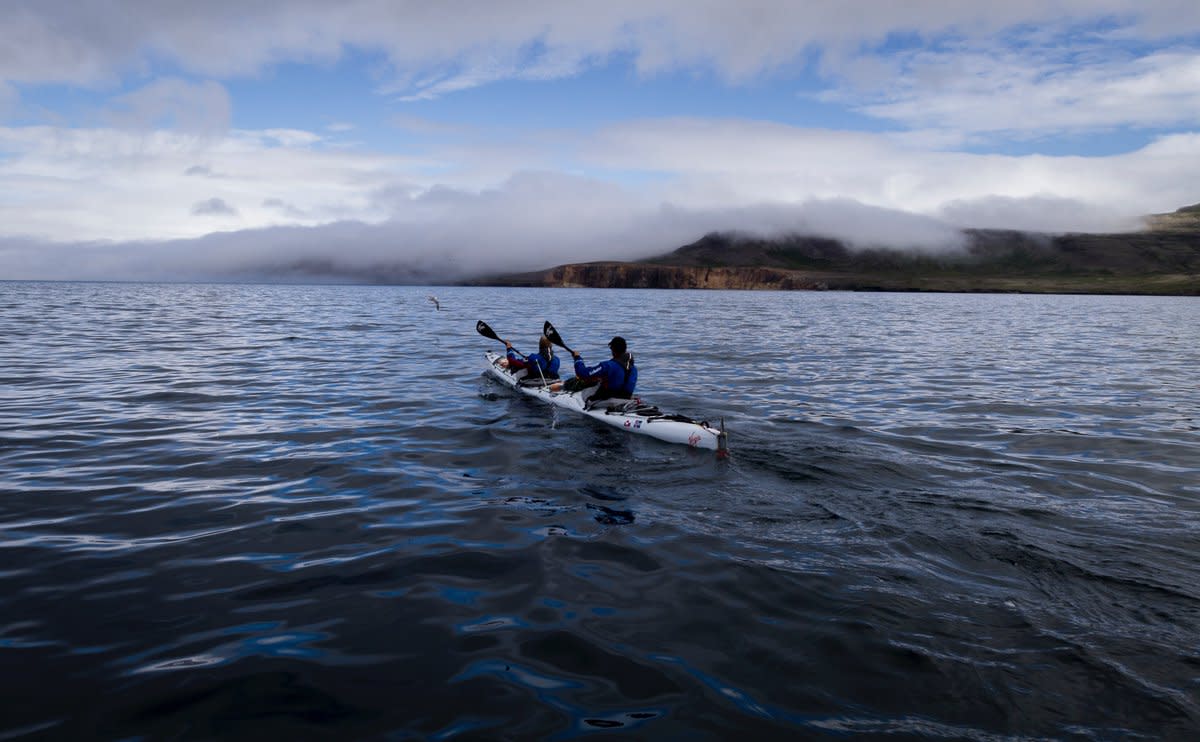
For the better part of the summer we've been following the progress of Olly Hicks and George Bullard, two British adventurers that had undertaken the difficult challenge of kayaking from Greenland to Scotland, and endeavor that included several legs of the journey that required them to be out on the open ocean for days at a time. Over the weekend, the pair reached their final destination at last, bring an end to their odyssey that was both mentally and physically taxing.

Hicks and Bullard launched their expedition from the Denmark Strait in Greenland before proceeding across open water to Iceland. From their, the two men followed the Icelandic coastline until they reached the North Sea, from which point they turned their boat towards the Faroe Islands, a very remote destination located just north of the British Isles. Next they crossed 50 miles (80 km) of rough seas to  reach the tiny island of North Rona before pressing on with the final leg, which ended
at Balnakeil Bay in Scotland. Along the way they faced several stops and starts due to inclement weather and exhaustion, but all told they managed to cover approximately 1200 miles (1931 km) over the the length of their adventure.

The expedition came to and end in the early hours of Sunday, September 4. Tired, but sensing that the end was near, Olly and George pushed on, paddling through the night. They reached Balnakeil Bay before sunrise, and although the blog reports of their progress say that they were exhausted, they were happy to reach the end of the journey at long last.

While this expedition saw little attention from the media, it was an audacious one to say the least. The waters that these two men paddled through were incredibly challenging, with ice floes blocking their way and heavy seas often making things rough. There are sections of the route that even commercial ships take care not to pass through, and yet Olly and George did it in a 22-foot sea kayak. That's a pretty impressive accomplishment indeed.

Congratulations to both men on a job well done.

Kamis, 01 September 2016

Video: The Ultimate Descent - From Everest to the Indian Ocean

In 2011, Sanobabu Sunuwar and Lakpa Tshiri Sherpa completed one of the most difficult and unexpected adventures in recent memory. The two men began by climbing to the summit of Everest, where they then deployed a paraglider and launched from the summit, flying down the Khumbu Valley to Namche Bazaar,  where they then embarked on the second stage of their journey – a kayaking trip down the Sun Kosi River that would ultimately take them to the Indian Ocean. Along the way they faced Class V rapids and the real threat of drowning, even as the Nepal military was searching for them since their Everest flight wasn't exactly sanctioned.

This video is from a news report about this crazy expedition. It was obviously filmed not long after they made the climb, flight, and paddle. The clip was recently posted online however, and for those that don't know the story, it is an interesting one. It was quite the adventure going from the summit of the world's tallest mountain to the sea level in just a few short weeks.

Video: Curious Humpback Whale Gets Close to Boat

Having spotted whales in the wild on a couple of occasions, I can tell you that it is a magnificent sight to see them up close. But, I've never seen them as close as they are in this video, in which a very curious humpback swims up to a boat to get a better look. The result is a clip that is about as close you can get to a massive whale without getting into the water yourself. Amazing stuff.

Columbia is Looking for New Directors of Toughness

Last year, gear manufacturer Columbia set the Internet ablaze when the went in search of two "Directors of Toughness." The position promised to be adventurous, sending the two people selected off to remote areas to test gear in some of the harshest conditions imaginable. It also offered a base salary of $39,000 plus benefits for nine months of work that involved lots of long days in the field. In exchange, the directors would blog about their experiences, video their adventures, and generally serve as online ambassadors for the Columbia brand. Sound like a dream job? If so, I've got good news for you. Columbia is hiring once again!

If you're interested in potentially becoming a Director of Toughness, you'll first need to register online to take part in a potential interview. Currently interviews are scheduled to take place on Mt. Hood in the state of Oregon, but future sites include somewhere on the East Coast of the U.S., as well as in Canada and the U.K. Exact locations will be announced at a future time. Follow Columbia on Instagram at @Columbia1938 for more details as to when those interviews will take place.

For more information about the Director of Toughness position visit the Application Page here. And to get a sense of what the job is all about, check out the video below.

Seems like a great opportunity for the right person. Good luck to everyone who applies!


Himalaya Fall 2016: Nobu Heads to Everest, Climbers Missing in Pakistan


The fall climbing season is upon us with several expeditions already underway in Nepal, while others begin to ramp up elsewhere. Last week several large teams set out for Manaslu, which will be a popular peak this season. Those climbers are just now getting settled into Base Camp where they will soon begin their acclimatization process. But elsewhere, things are starting to get very interesting.

Japanese climber Nobukazu Kuriki reportedly left Kathmandu for Lhasa, Tibet yesterday. After making five previous attempts to climb Everest from the South Side in Nepal, he'll make his sixth attempt from the North Side instead. Kuriki says that after he acclimates, he'll attempt to climb the Great Couloir route in alpine style solo and without oxygen.

In 2015, Kuriki attempted the same approach from the South Side only to be turned back at Camp 4 due to high winds and deep snow. This year he hopes to have more success, with a change in scenery helping to bolster is efforts. Back in 2012 he famously got stranded high on Everest and had to be rescued, but severe frostbite cost him parts of nine fingers. 

Hopefully he'll find more success this year. 

When he gets to BC on the North Side he won't be alone. Spanish ultrarunner Kilian Jornet is already there, and has been acclimatizing for his attempt at a new speed record on Everest. He'll also make one push up the mountain, climbing without oxygen, and incredibly lightweight gear. There is no word yet on when that attempt might come, and there have been few updates on his progress in recent days. For now, we wait.

Finally, there is some sad news out of Pakistan, where the Karakoram climbing season has essentially just wrapped up. Climbers Kyle Dempster and Scott Adamson have gone missing on the Ogre II, and search and rescue operations are currently underway there. 

The duo haven't been seen in last Monday – August 22. On that evening, the headlamps of the two American's were spotted heading up the mountain but poor weather moved in over the ensuing days, obscuring the view from Base Camp. Dempster and Adamson had planned to spend five days on their summit bid, which would have put them back in BC by August 26. There has been no word from them however, so friends and family have been raising funds to pay for a search team to begin looking for the missing men. 

The Ogre is also known as Baintha Brakk, and is considered amongst the most difficult mountains in the world. Standing 7285 meters (23,901 ft) in height, it is both a technical and physically demanding climb. The approach is incredibly steep and dangerous which is why 24 years past between the first ascent in 1977 and the second in 2001. Dempster himself paired with Hayden Kennedy to climb Ogre for the third time in 2012. 

Hopefully the two men will be found safe higher up on the mountain, but unfortunately that is seldom the case. Lets continue to hold out hope however, as there is still a chance they are alive and in need of some assistance in getting down. 

That's all for now. More updates to come soon. 

Comprehensive Elephant Census in Africa Brings Sobering News

As someone who has a deep, personal love for Africa and the amazing wildlife that lives there, this story was particularly sad to read. Yesterday, the results of a comprehensive census of the African elephant population were released, and the were sobering to say the least.

The study was conducted by an organization called the Great Elephant Census, which is backed by Microsoft co-founder Paul Alan's Vulcan organization. Using a method of arial data collection and surveillance, researchers have come to the stunning conclusion that there are now only 352,271 elephants left on the African continent. That population is spread out over 18 countries and is estimated to be down 30% in just 7 years. That's the equivalent of 144,000 elephants lost between 2007 and 2014.

According to the findings, the current elephant population loss is about 8% per year, with roughly 100 animals killed each and every day. Most of that is due to illegal poaching as the demand for ivory remains high in certain parts of the world, including Asia and even the United States. Measures have been taken recently to stem the sale of Ivory across the globe, but a thriving black market remains.

The 352,000 elephants counted in the census are believed to be at least 93% of the population that still exists in the 18 countries surveyed. That number could be higher, but it is difficult to track them completely precisely. Of those counted as part of this research study, 84% lived on protected lands, with the remaining population spotted outside preserves and national parks where they don't receive any kind of protection at all. That said, many carcasses were found inside those protected regions as poachers ignore laws and cross boundaries to seek their prey.

As you can imagine, with such a massive drop in numbers over the past decade, the possible extinction of the wild elephants in Africa is a real possibility within our lifetimes. Having seen these magnificent creatures up close and personal both on foot and from a vehicle, I can't imagine them not being a part of the wild landscape on that continent. But, if poaching continues at its current rate, they may be completely gone in as little as 20 years. When you consider that at one point, there were more than 20 million elephants in Africa, you begin to get some perspective about just how decimated the population is there.

Sad news for conservationists for sure. Lets hope we can turn this trend around in the near future.